


How a surfboard is made: shaping and glassing at Cross Design
From a conversation at the counter to a finished board with your dimensions written on it: every stage of a custom, as it happens in our factory.

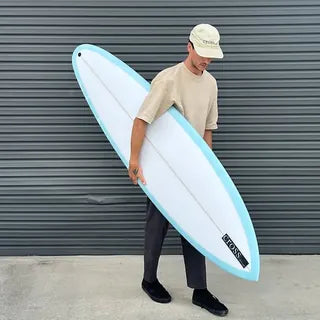
A custom surfboard is made in stages: a conversation about how you surf, a foam blank chosen for the board, hand shaping of the outline, rails, rocker and bottom, colour, glassing in fibreglass and resin, fins, and a final sand and finish. At Cross Design every one of those stages happens under one roof in Currumbin Waters, done by the same person. In Junkyard Surf’s words, shaping, glassing, colour work and repairs all happen in Joe’s workshop.
Here is each stage, with photos from the factory.

1. The conversation
Every board starts with a free consultation. Joe wants to know how you surf: your ability, height, weight and fitness, where you surf and what you ride now. As the Junkyard Surf feature put it, he wants to know how you surf “so he can build around you, not a set of stock dimensions.”
From that comes an outline (one of our models, such as the Blade or the Asym | Mid) and a set of dimensions. If you want a head start, the volume calculator gives you a first number to bring along.

2. The blank
A surfboard starts as a foam blank. We build in PU (polyurethane, usually with a timber stringer down the middle) and EPS (expanded polystyrene, glassed with epoxy). The two feel quite different, and EPS vs PU explains how.
Joe has credited South Coast Foam, Shapers Manufacturers Co, Burford Blanks and Foam Australia for blanks and materials.

3. Shaping
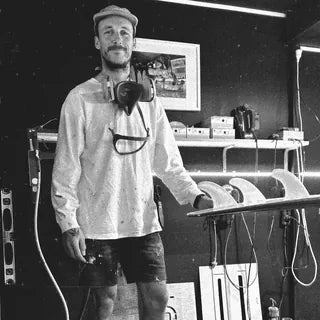
This is the part most people picture. The outline is marked onto the blank, cut out, and then the board is shaped by hand: planing the deck and bottom to the right thickness and rocker, turning the rails, and working the bottom contours and the tail. It is slow, careful work, checking curves by eye and by hand.

Customers sometimes see their board take shape. In March 2026 Tiggs filmed Joe in the bay and wrote that it was “Awesome to have Kobe there to see his new board take shape”.

4. Colour
Colour can go on before glassing or with it. Sprays go onto the shaped foam, so they end up sealed under the glass; tints and solid colour go into the resin during glassing; swirls are poured and folded as the board is glassed. Logos and decals are placed at this stage too: one of Joe’s stories shows him “Preping decals for logo placement & spray work”. The four kinds of colour are explained in the colour guide.

5. Glassing
Glassing is what turns a shaped piece of foam into a surfboard. Fibreglass cloth is laid over the blank and wet out with resin, wrapping onto the rails as a lap, first on one side and then the other. Resin choice follows the foam: epoxy for EPS, and polyester is the traditional partner for PU. Cloth weight and type change the strength and flex, and Carbon Fiber is available on the whole range.

6. Fins
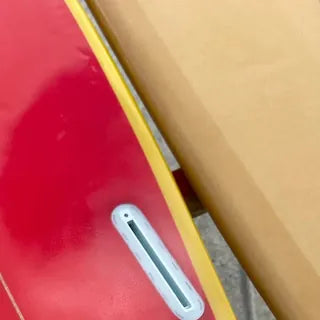
Fin boxes, such as the official Futures boxes on every Blade, are set into the board at the right angle and glassed in. Or the fins can be glassed on so they become part of the board. Joe also makes fins himself, from fibreglass panels he lays up in the factory and tints to Pantone colours. That side of the work is on the custom fins page.
7. Sanding and finishing
After glassing come the hot coat and the sanding. Joe captioned one rack of new boards “Time to sand these beauties”. Every board comes in a matt finish, and gloss can be added over the whole board, which means more coats and a lot of polishing.
Then the dimensions are written on by hand, and the board goes out with grub screws and a leash rope. From order to pick-up takes 4 to 6 weeks.

Why it all happens in one place
Because one person does every stage, nothing is lost between them. The conversation you have at the counter goes straight into the shape, the person glassing the board knows where the inlay or the pin line has to sit, and the person who repairs boards every day knows what makes one last. It is also why Joe can come back to a board and refine it with the surfers he works with, which is how the Duo | Mid reached its sixth version.
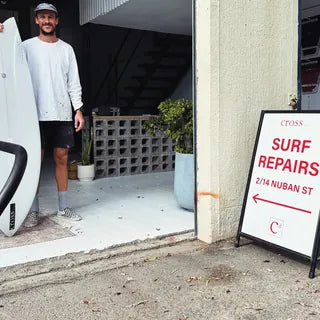
If you would like to see it, the factory is at 2/14 Nuban St, Currumbin Waters, open Monday to Friday 9am to 4:30pm and Saturday 9am to 12pm. There is more about the building in our new factory, and more about Joe on the about page.
The craft, in our customers' words
Best Team, so much passion and love goes into every board. Can only recommend!
Looking for someone to trust with your sacred surf board? If you’re like me your board is a part of you. It’s like a pet, it’s family. Not everyone can be trusted with something so dear to you. Well, look no further. You’ve found Joe at Cross Design. The man exudes passion for surfing and craftsmanship. Every fine detail is poured over. Every board is treated as if it’s his own. Every worry you may have is put to ease with his skill set and experience.
Plus, ya know, you get to support local. So get into the shop asap. Anything from dings to the brand new thing. Joe’s got your board and he’s got your back.
Thanks Joe!


