

Surfboard colour: resin tints, swirls and sprays explained
A resin tint, an opaque pigment, a swirl and a spray are four different jobs with four different looks. Here is how to tell them apart.

Colour goes onto a surfboard in four main ways: a resin tint (see-through colour in the glass), an opaque pigment (solid colour), a resin swirl (colours folded together as the board is glassed) and a spray (paint, usually on the foam under the glass). Each gives a different look, takes a different amount of time and suits a different kind of board.
So “Can you do it in green?” is an easy question with four possible answers.
If you know which is which, you can brief your shaper in one sentence and get what you pictured.

1. Resin tint
A tint is colour mixed into the laminating resin itself, in a small enough amount that the resin stays see-through. The colour is in the glass, not on the foam.
The look is deep and translucent, a bit like coloured glass. You can see the weave of the cloth and the stringer through it. Where the cloth overlaps on the rails, the colour doubles and you get a darker band, which is part of the charm.
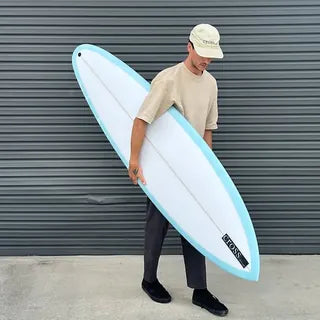
Tints suit classic shapes: fish, mid-lengths, logs. Joe has done a Duo | Mid “with a dark blue tint” and boards with an aqua tint and custom graphics. He also tints the fibreglass panels he makes fins from, matching the colour against a Pantone book before he mixes.

2. Opaque pigment
Same method, more colour. With enough pigment in the resin you can no longer see through it, and you get a solid, flat, saturated colour.
This is what most people mean by a “colour lap”: the bottom glassed in one colour and wrapped onto the rails, the deck in another or left clear. Solid colour laps, top and bottom, are included in the cost of every board we make. A Blade Performance Pin went out with what Joe called a “one off grey bottom lap”.
Solid colour looks clean and modern. A sage green Retro Fish, a lavender one, and a Modern Fish in what Joe called “sunburnt orange” have all left the factory.


3. Resin swirl
A swirl uses two or more colours of resin, poured together and moved across the board as it is laminated. The colours fold into each other and set that way.
No two are the same, and nobody can fully control one, including the person pouring it. You choose the colours and the general mood, and the resin does the rest. Joe has posted an “ocean blue pigment swirl”, and the grey Blade lap mentioned above was finished “with white swirl”.
If you want a swirl, bring reference photos of ones you like and pick two or three colours. Then let go of the details. If you need the left rail to look exactly like the picture, a swirl is the wrong choice.

4. Spray
A spray is paint, applied with a spray gun. It usually goes onto the shaped foam before glassing, so it ends up sealed under the fibreglass. It can also go on over the finished glass.
Sprays are the way to get hard edges, fades, stripes, panels and artwork. The same skill restores old boards: a full respray, new stripes, or a faded rail brought back. That side of the work, for surfboards, boats and Jet Skis, has its own page: paint and resprays.
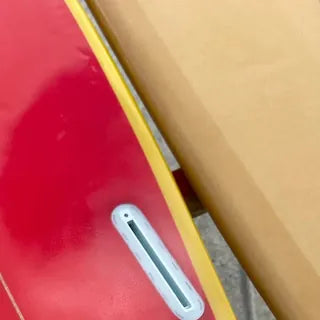
Joe sprays in house. The same gun does repair work too: a rail repair on a customer’s shortboard in October 2025 went back out with what he called “a drift red spray”.

The extras
Pin lines. Thin painted lines that follow a colour change or the cut lap of the glass. They tidy an edge and add a lot of class for a small detail. They also take patience. Bec’s longboard had gold pin lines on both sides, and the whole board took about 20 hours. That one has its own write-up.
Gold leaf. In September 2025 Joe made a Duo | Mid “Inspired by Mana Crystal - with Gold Leaf”.
Stringer and logo choices. A coloured or black stringer changes a white board more than you would expect. Joe’s own Duo | Mid has a black stringer and glossed logos.

Inlays. Flowers, shells, feathers or a photo under the glass. See Inlays.

Matt or gloss
Every board comes in a matt finish, included in the price. Gloss can be added over the whole board, which means extra coats and a lot of polishing. It makes tints and swirls look deeper and wetter, and it is the traditional finish for a log. You can also gloss just part of a board, such as the logos.

What is included, and what is extra
Solid colour laps are included. Swirls, sprays, pin lines and anything more involved are extra, because they add hours. We quote them with the board, since the price depends on the size of the board and what you are asking for.
Colour matching on repairs
The same eye gets used on the repair bench. When a ding is fixed on a coloured board, the new resin has to be mixed to match colour that has been in the sun for a few years. Colour matching is one of the things our repair customers mention most in their Google reviews (two are below), and Google lists it as a review topic.
If you have a coloured board that needs work, text a photo to 0422 435 689 and Joe will tell you before he starts how close a match is realistic. The surfboard repairs page covers the rest.

How to brief it
- Say which of the four you want: tint, solid, swirl or spray.
- Bring a reference. A photo, a paint chip, a favourite T-shirt.
- Say where: deck, bottom, rails or all over.
- Mention the finish, matt or gloss.
If the shade you want is not on the Colour page, that is fine. As the board pages put it: “No worries. I’ll make it up for you.”
Colour matching, in our customers' words
Joe did an amazing job repairing my longboard. The colour match is perfect and like new again. It was finished within a few days and the whole process was very easy with no hassle dropping it off or picking it up. Really happy with the repair and would definitely recommend!
Second time getting my boards repaired by Joe and super happy again! He fixed two boards for me and the colour matching was perfect. Great repairs and super friendly service. Thanks Joe! 🤙


