



Epoxy surfboard repair: why EPS boards need epoxy resin, and what to do first
Polyester resin melts polystyrene foam. That one fact decides how an epoxy board is repaired, and what you should and should not do before it comes in.

An epoxy surfboard, which almost always means an EPS (expanded polystyrene) foam core glassed with epoxy, has to be repaired with epoxy resin. Polyester resin dissolves polystyrene foam, so a polyester repair on an EPS board eats the foam under it. Keep the dinged board dry and out of the sun, do not patch it with a polyester kit, and get it sealed properly.
At Cross Design, EPS and epoxy boards are repaired with epoxy, never polyester, and the shortboard price list covers PU and EPS boards alike. Here is the longer version, including how to tell what your board is made of.
Why epoxy boards need epoxy resin
Surfboards come in two main constructions:
- PU (polyurethane) foam, usually with a timber stringer, glassed with polyester resin. The traditional board.
- EPS (expanded polystyrene) foam, made of small beads fused together, glassed with epoxy resin. Lighter, floats higher, and usually called an "epoxy board".
Polyester resin contains styrene, a solvent that attacks polystyrene. Put polyester on exposed EPS foam and the foam softens and melts away. Even if the repair looks fine on day one, it has nothing solid underneath and will fail.
Epoxy resin does not attack either foam, so it is safe on EPS and on PU. That is the rule in one line: epoxy works on both, polyester only on PU. Some PU boards are also glassed with epoxy, and those get repaired in epoxy too, so the finish bonds to what is already there.
There is a full comparison of the two foams, how they ride and how they wear, in EPS vs PU surfboards.

How to tell if your board is epoxy
Most of the time the board tells you.
| Clue | Epoxy and EPS | PU and polyester |
|---|---|---|
| The label | "EPS", "epoxy" or a brand’s own construction name near the logo or on the stringer | Often no label, or "PU" |
| Weight | Noticeably light for its size | Heavier for the same size |
| Inside a ding | White beads, like a foam esky | Fine, even foam, often yellowed with age |
| Stringer | Often none, or a carbon strip | Usually a timber stringer down the middle |
| Sound | A hollow, drum like knock | A duller knock |
None of these is perfect on its own, and some boards mix materials. If you are not sure, send a photo of the ding and the logo area, and Joe will tell you what it is.
What to do before you bring it in
EPS dings need a little more urgency than PU dings. The foam is made of beads, and water that gets in through an open ding can travel between them, a long way from the hole. Here is what helps, in order.
- Get out of the water. Do not keep surfing an open ding, even a small one.
- Let it drain. Stand the board with the ding facing down so water can run out. Do not rinse fresh water into the hole.
- Keep it cool and dry. Out of the sun, out of a hot car and off the roof racks. Heat makes trapped water and air expand, which can lift the glass around the ding.
- Do not reach for a polyester kit. If a quick fix is the only way to get home, use a temporary ding tape, and tell us what went on it.
- Take photos. One close-up of the damage, one of the logo or label, and one wider shot of the whole board.
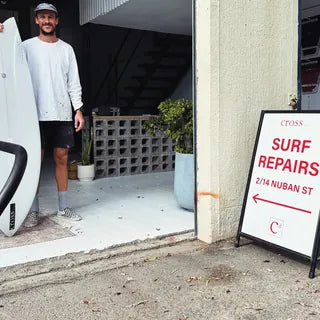
Then send the photos for a free quote, or drop in to 2/14 Nuban St, Currumbin Waters. Walk-ins are welcome during shop hours.


What a proper EPS repair involves
The steps are the same as on any surfboard repair, with epoxy in place of polyester all the way through:
- Open up the damage and cut back any crushed or loose glass and foam.
- Dry it out properly. On an EPS board this matters more than anywhere, because water hides between the beads.
- Fill or rebuild the foam where it is missing.
- Laminate new fibreglass cloth over it with epoxy resin, overlapping onto sound glass.
- Fill coat, sand and fair it flush with the rails and deck.
- Colour match, so the repair disappears into the original finish.
Every repair is done by Joe in our Currumbin Waters factory. He shapes and glasses boards in both EPS and PU, so he knows how the board in front of him was built, and repairs it the same way.

What an epoxy ding repair costs
The printed shortboard job sheet in the factory covers PU and EPS boards on the same list. These are the guide prices.
| Shortboard repair (PU or EPS) | Guide price |
|---|---|
| 1 ding | $90 |
| 2 dings | $110 |
| 3 dings | $150 |
| Lots of dings | $220 to $400 |
| Colour match | $50 to $300 |
| Crease | $200 |
| Snap (centre) | $400 |
Guide prices. Joe confirms the exact price from your photo.
Longboards, foils, skis and boats have their own lists on the surfboard repair price list. Anything that is not on a list, such as delamination or a full respray, is quoted from a photo. There is more on how prices are worked out in surfboard ding repair cost.
Can I fix an epoxy board myself?
Small, clean dings above the waterline are the classic home repair, and plenty of surfers do them. If you do, three things matter on an EPS board:
- Use epoxy only. UV cure "ding" resins come in polyester and epoxy versions. Check the label, and only use the epoxy one on EPS.
- Dry it first. Sealing water inside an EPS board is how a small ding becomes delamination.
- Know when to stop. Cracks, creases, rail damage, anything soft around the ding, or a ding that has been surfed wet for a while are jobs for the workshop.
If a home repair has already gone wrong, send a photo anyway. Joe would rather tell you straight what it needs than have you guess. Full details on the surfboard repairs page.
Questions
More answers on the surfboard repairs page and in the FAQ.
Can you use polyester resin on an epoxy surfboard?
Not on an EPS board. Polyester resin contains styrene, which dissolves polystyrene foam, so the repair eats the foam underneath it. EPS and epoxy boards are repaired with epoxy resin.
What is the best resin for repairing an epoxy surfboard?
Epoxy resin. It bonds to the existing epoxy glass and does not attack EPS foam. It is also safe on PU boards, which is why epoxy is the safe choice when you are not sure what a board is made of.
Do you repair epoxy and EPS surfboards?
Yes. Any brand, in PU or EPS. EPS and epoxy boards are repaired with epoxy, never polyester, and the shortboard guide prices are the same for both, from $90 for one ding.
Why does a dinged EPS board need fixing quickly?
EPS foam is made of fused beads, and water that gets in through an open ding can travel between them. The longer it is surfed wet, the bigger the repair. Get it out of the water, let it drain and keep it out of the sun.
How do I know if my surfboard is epoxy?
Look for "EPS" or "epoxy" on the board, notice the weight (EPS boards are light for their size), and check inside a ding: white beads mean EPS. If you are unsure, send a photo and Joe will tell you.


