



Twin fin surfboards explained: twin fins vs a thruster
Two fins instead of three: what changes under your feet, who a twin suits, and how the Duo was drawn around it.

A twin fin surfboard has two fins, one near each rail, and no centre fin. Compared with a thruster (three fins), a twin has less drag, so it picks up speed quickly and feels loose and skatey, which makes it fun in small to medium surf. A thruster’s centre fin adds hold and control when the waves get steep and powerful. A good twin is drawn around that trade-off, and that is what our Duo is built to do.
This is a plain guide to what two fins do, who a twin suits, and how the twins Joe shapes in Currumbin Waters handle it.

What two fins change
Fins do two jobs: they give the tail something to hold onto, and they let you drive off the bottom and back up the face. Every fin you add gives more hold and more drag. Every fin you take away gives less of both.
With two fins:
- The board accelerates quickly and keeps speed through soft or flat sections.
- It feels loose. It slides and pivots more easily, especially off the tail.
- It has less grip when the wave stands up. Turns at full rail on a steep face need more finesse, and the tail can let go.

With three fins (a thruster), the centre fin gives the tail a pivot point to push against. The board holds a line better in steep, powerful surf and feels more predictable at full rail. In small, weak waves that same fin is extra drag.
Neither is better. They are tools for different days, and many surfers end up with one of each.

Who a twin suits
A twin is a good choice if:
- Most of your surf is small to medium and a bit soft, which describes a lot of days on the southern Gold Coast.
- You already surf a shortboard and want something faster and looser for the in-between days.
- You like drawing long, flowing lines more than snapping hard at the lip.
- You want a fish or a mid-length that keeps its speed down the line.
Think twice if your main waves are steep, hollow or powerful, or if you are still learning to turn. In those cases a thruster, or a twin with a tail outline designed for hold, is easier to trust.

How the Duo handles it
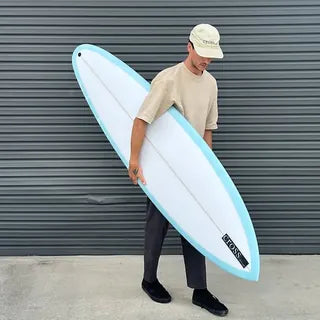
The Duo is our twin pin. Joe describes it as an evolution of the classic fish: its refined pin tail outline gives an easier transition onto the rail and more control when the waves have more power. That is the twin’s weak spot, dealt with in the outline rather than with a third fin.
It also has extra thickness through the chest and a flatter entry rocker, so it comes alive in small surf, where a twin is at its best. It is made for waves from about 2ft to 6ft on the face, in all conditions, for intermediate to advanced surfers.

Recent Duos have run from 5'8" to 6'8". Team free surfer Zac Martens rides his at 5'8" x 20" x 2 1/2". And because every board is custom, the set-up can change too: in February 2026 Joe shaped a one-off 6'8" Duo as a quad with a diamond tail.

The mid-length twin
Joe has also taken the same idea into a mid-length. The Duo | Mid, one of his earlier mid-lengths, grew out of the Rose | Mid, with a refined nose for taking off deeper and a rail that rolls over smoothly into turns.
A mid-length twin is about as easy as surfing gets: plenty of foam to paddle in early, and two fins to keep it gliding through the flat parts. The Duo | Mid reached a sixth version, refined with the surfers Joe works with, and the story is in Duo | Mid Mk.6. Our current mid-length, the Asym | Mid, can run a classic twin: see the mid-length page.

Other twins from the bench
Twins turn up across the range.
- The Asym | Mid can be set up as a classic twin, among other fin options.
- A Modern Twin, 5'9" x 20" x 2 1/4", went out with an aqua tint in January 2025.
- A 6'6" Asymmetric Mid-length went out in 2022 with hand-shaped, glassed in wooden fins.

Fins for a twin
The fins matter as much as the board. Twin fins are usually bigger than thruster side fins, with a longer base, because two fins are doing the work of three.
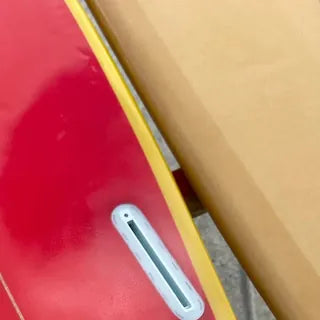
Joe makes fins in house. He lays up his own fibreglass panels (“That’s what 38 layers looks like”), tints them to Pantone colours, and cuts and foils each fin by hand. He has made hand-shaped wooden fins too, and glass-on fins for boards being restored. If you want fins made for your twin, or glassed in for good, start on the custom fins page.

If you are thinking of converting an existing board, that is fin box work: see fin box repairs and conversions.
Twin fin vs thruster: a quick comparison
| Twin fin | Thruster | |
|---|---|---|
| Fins | Two, one near each rail | Three: two side fins and a centre fin |
| Feel | Fast, loose, skatey | Controlled, predictable |
| Best waves | Small to medium, soft or flat sections | Steeper, more powerful waves |
| Watch for | Less hold at full rail in steep surf | More drag in weak surf |
| Our boards | Duo, twin set-ups on the Asym | Mid | Talk to Joe about your outline |
Getting yours right
A twin is very sensitive to its outline, its tail and how much foam is under your chest. That is where a custom helps: Joe draws the length, width, thickness and tail around how you surf and where. Get a starting number from the volume calculator, read what size surfboard should I get, then bring it to the consultation.
The Duo starts from $1,200 and the Asym | Mid from $1,400. Both take 4 to 6 weeks and come with grub screws and a leash rope.

Questions
More answers in the Cross Design FAQ.
Is a twin fin good for beginners?
A mid-length suits beginners through to advanced surfers, because the length and foam make it easy to paddle and stable, and our Asym | Mid can be set up as a classic twin. Shorter twins like the Duo are better for intermediate surfers and up, who already turn comfortably.
Twin fin or thruster for small waves?
In small, soft waves a twin usually feels faster and more fun, because it has less drag. A thruster gives more control when the waves get steep and powerful.
Can a twin be set up with other fins?
On a custom, yes. Joe has shaped a Duo as a quad with a diamond tail, and the Asym | Mid can run a quad, an asymmetric set-up or a classic twin. Talk it through at the free consultation.


