


How to build a surfboard quiver: groveller, hybrid and step-up for the Gold Coast
A good quiver is a set of boards that each do one job well, without overlapping. Here is how to build one around the waves the Goldy actually gets.

A surfboard quiver is a set of boards that each cover a different range of waves. For the Gold Coast, a two board quiver is usually a small wave board (a groveller or hybrid) plus an everyday shortboard or mid-length. A three board quiver adds a step-up for cyclone swell and solid days on the points. Each board should start where the last one stops.
Most surfers do not need five boards. They need two or three that do not overlap. Here is how to pick them, using the wave ranges published for each of our outlines.
What is a groveller, a hybrid and a step-up?
These are the three words you will hear most when people talk about quivers.
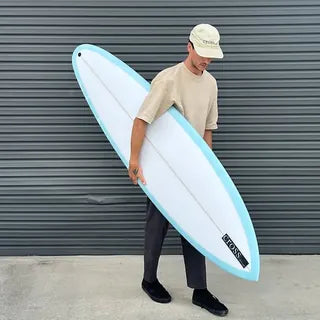
A groveller (often spelt groveler) is a small wave board: wider, flatter and fuller than a standard shortboard, so it keeps moving on soft, gutless days. Our Blade is exactly that. The Blade Mk3 is described on its board page as "a performance grovelling machine for the surf most of us get most days", with a medium entry rocker, a wider profile than a typical shortboard and a flatter deck, for 2ft to 6ft waves. It is ridden about 1 inch shorter than your height.
A hybrid sits between a shortboard and a fish: more foam and a flatter rocker than a performance shortboard, but still a shortboard you can turn hard. Our closest outlines are the Duo, an evolution of the classic fish with extra thickness under your chest and a flatter entry rocker, and the Retro Fish. Both are for 2ft to 6ft waves.
A step-up is a slightly longer board for bigger, more powerful surf. The extra length gives you paddle speed to get in early and more rail to hold a line. If you want one, talk it through with Joe at the free consultation.

The Gold Coast in one paragraph
The southern Gold Coast has two kinds of wave that matter here: the points, Snapper, Kirra, Currumbin Alley and Burleigh, with long running walls; and the beach breaks in between, which are shorter, shiftier and close out more. Much of the year it is small and soft, which is where a groveller earns its place. Then a few times a season the points light up with cyclone swell, and that is what a step-up is for. A Gold Coast quiver has to cover both ends.
Two board quivers
Pick the row that sounds like how you surf. The waves are the face heights published on each board page.
| Your surfing | Board 1: small days | Board 2: good days |
|---|---|---|
| Shortboarder, intermediate to advanced | Retro Fish or Duo, 2ft to 6ft | Blade, 2ft to 6ft |
| Shortboarder who wants something different | Duo, 2ft to 6ft | Asym, 2ft to 6ft |
| Mid-length surfer, any level | Nude | Longboard, any longboardable wave | Asym | Mid, 3ft to 6ft |
The idea in each row is the same: the first board catches everything when it is small, the second takes over when the waves have some push. If you only surf on good days, the second board might be the only one you need.

Three board quivers
Adding a third board fills the gap the other two leave.
| Your surfing | Small and soft | Everyday | Third board |
|---|---|---|---|
| Performance shortboarder | Retro Fish, 2ft to 6ft | Blade, 2ft to 6ft | Asym, 2ft to 6ft |
| All-rounder | Retro Fish, 2ft to 6ft | Asym | Mid, 3ft to 6ft | Duo, 2ft to 6ft, for days with more push |
| Longboard first | Nude | Longboard, any longboardable wave | Asym | Mid, 3ft to 6ft | Duo, 2ft to 6ft, for days with more push |
Duo, Asym and Blade are published for intermediate to advanced surfers. The mids, the Retro Fish and the Nude | Longboard are published for beginner to advanced.
A real quiver: Zac’s boards
Zac Martens, our team free surfer, rides more of the range than anyone. These are the dimensions Joe posted for his boards.
| Board | Dimensions | Posted |
|---|---|---|
| Blade | 5'10" x 19 1/8" x 2 3/8", 27.93 L | Instagram, Oct 2025 |
| Duo | 5'8" x 20" x 2 1/2" | Instagram, Jan 2026 |
| Fish | 5'5" x 20" x 2 1/2" | Instagram, Jan 2026 |
| Modern Fish | 5'8" x 20" x 2 1/4" | Instagram, Oct 2025 |
| Nude | Longboard | 9'4" x 23" x 3" | Instagram, Jun 2026 |
Look at how the boards are spread. The Blade is the narrowest and thinnest, the performance board. The Duo, fish and Modern are all 20" wide, short and full, for the smaller, softer days. The Nude covers the days when a shortboard makes no sense at all. Five boards, but almost no overlap. Most people only need part of it. More on Zac and the team on the team riders page.

How to space the boards
- Start with the board you ride most. That is the middle of the quiver; everything else is measured against it.
- Spread the wave ranges, not the colours. If two boards both cover 2ft to 6ft beach breaks, one of them is spare.
- Groveller fuller, step-up longer. A small wave board usually carries a little more volume through a wider outline; a step-up gets its extra paddle power from length and holds better through a narrower tail.
- Keep the fin system the same. If every board uses the same fin boxes, one set of fins moves between them.
- Size each board to you. Use the volume calculator for a starting number per board type, and read how to size a custom surfboard.

Building a quiver over time
Nobody orders three customs at once. A good order is to replace the board you ride most first, then fill the gap you notice most: if you sit on the beach on small days, the groveller; if you sit on the beach on big days, the step-up. Bring what you ride now to the consultation. What you like and do not like about it is the most useful information Joe can get.
Boards are ready 4 to 6 weeks from purchase, so order a step-up before the cyclone season, not when the swell forecast lands. You can start a custom order by calling or texting Joe on 0422 435 689, or dropping into the factory.
Questions
More answers in the Cross Design FAQ.
What is a hybrid surfboard?
A board between a shortboard and a fish: more foam and a flatter rocker than a performance shortboard, but still a board you can turn hard. Our closest outlines are the Duo and the Retro Fish, both for 2ft to 6ft waves.
What is a groveler surfboard?
A small wave board, wider, flatter and fuller than a standard shortboard, made to keep moving on soft days. Our Blade is built for exactly that: medium, slower and less powerful waves from 2ft to 6ft, ridden about 1 inch shorter than your height.
How big is a step-up surfboard?
Usually a few inches longer than your everyday shortboard. Joe works out the length with you at the free consultation.
How many surfboards should be in a quiver?
Two or three for most surfers: a small wave board, an everyday board and, if you surf big days, a step-up. Each one should cover waves the others do not.


